In a major step toward transparency and user convenience, the Benazir Income Support Programme (BISP) has announced an important policy change regarding wallet account SIMs for eligible women beneficiaries.
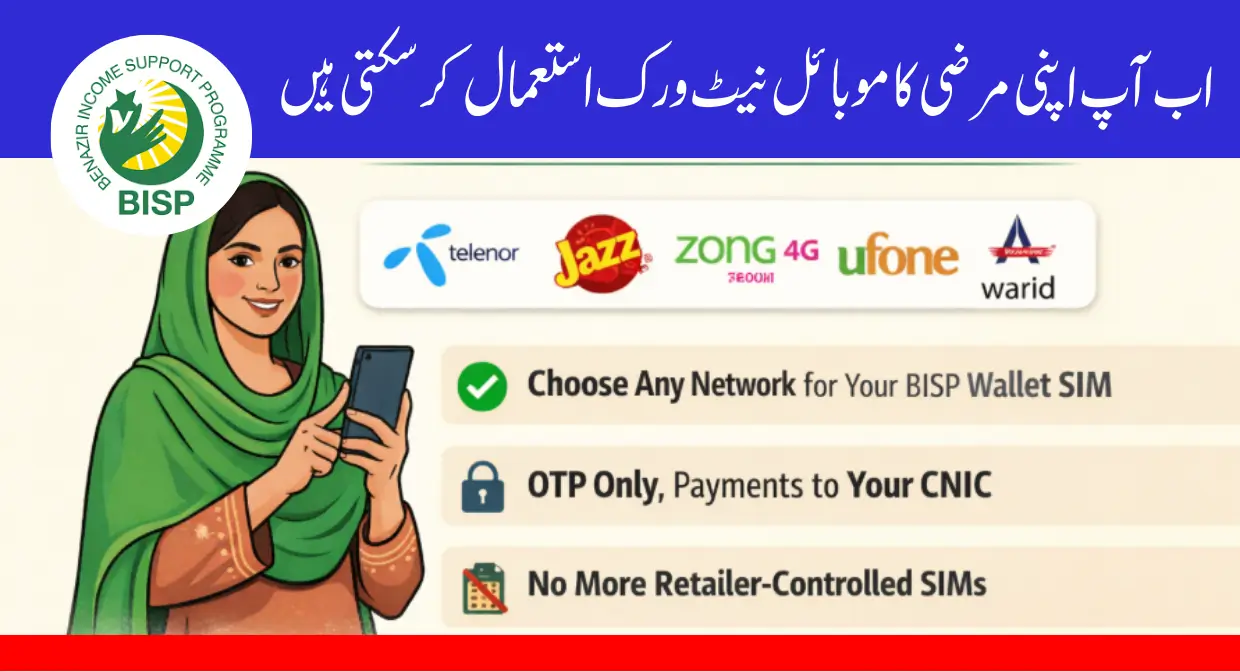
Under the new decision, women enrolled in BISP will now have the freedom to use any mobile network of their choice for their wallet account, instead of being assigned a SIM by retailers at camps or centers.
Women Can Now Choose Their Preferred Network
Eligible women can link their BISP wallet account with any of the following mobile networks:
- Telenor
- Jazz
- Zong
- Ufone
- Warid
This applies both to new SIMs and existing mobile numbers that are already registered against the woman’s CNIC.
Retailers Can No Longer Assign SIMs Arbitrarily
Previously, many beneficiaries reported that retailers at BISP camps or payment centers would issue SIM cards of their own choice. This practice often created confusion, technical issues, and concerns about misuse.
With the new policy:
- Retailers will no longer be allowed to issue SIM numbers based on their preference
- The final choice of network and number will rest entirely with the eligible woman
- Only CNIC-verified numbers can be linked to the BISP wallet
This move directly addresses long-standing complaints from beneficiaries across Pakistan.
SIM Use Limited to OTP Verification Only
According to BISP officials, the linked SIM will be used only for OTP (One-Time Password) verification purposes.
Key clarifications include:
- The SIM is not used to store or receive funds
- OTPs will be sent to verify identity during transactions
- Financial transfers will always be made to the woman’s CNIC, not to the SIM
This ensures that even if a phone is lost or changed, the beneficiary’s funds remain secure.
Payments Remain Fully CNIC-Based
BISP has clearly stated that:
- All payments will continue to be issued strictly against the beneficiary’s own CNIC
- No third-party number or identity can receive the funds
- The SIM only acts as a security and verification layer
This system reduces the risk of fraud, identity misuse, and payment diversion.
Why This Decision Matters
This policy change is being widely welcomed because it directly benefits women in several ways:
- Greater control over their own accounts
- Freedom to use a network with better coverage in their area
- Reduced dependence on retailers or middlemen
- Improved transparency and trust in the payment system
For women in rural and remote regions, network choice can significantly affect OTP delivery and transaction success.
A Step Toward a More Transparent System
BISP has described this decision as part of its broader effort to modernize payment systems and strengthen beneficiary protection. By limiting the role of retailers and empowering women to make their own choices, the program aims to build a fair, secure, and user-friendly digital payment ecosystem.
What Beneficiaries Should Do Next
Eligible women are advised to:
- Ensure their mobile number is registered on their own CNIC
- Choose a network with reliable coverage in their area
- Avoid sharing OTPs with anyone
- Report any retailer who attempts to force a specific SIM
This announcement reflects a strong commitment by BISP to women’s empowerment, financial security, and system transparency—marking another important milestone in Pakistan’s social protection framework.
Also Read: Best Method to Check 8171 Status Online with CNIC in Just Minutes
Conclusion
This latest decision by the Benazir Income Support Programme marks a meaningful shift toward women-centered digital inclusion and financial security. By allowing eligible women to choose their own mobile network or link an already CNIC-registered number, BISP has reduced dependency on retailers and closed a major gap that often led to confusion and misuse.
Limiting the SIM’s role to OTP verification while keeping all payments strictly CNIC-based strengthens trust, protects beneficiaries from fraud, and ensures that financial assistance reaches the rightful recipient every time. More importantly, this change gives women greater control, convenience, and confidence in managing their BISP accounts.
Overall, this policy reflects BISP’s commitment to transparency, empowerment, and a safer payment system—one that respects choice, improves accessibility, and puts women firmly in control of their own support benefits.
Related FAQs
1. What is the new BISP wallet account SIM policy?
BISP now allows eligible women to choose any mobile network or use an existing CNIC-registered number for their wallet account instead of receiving a SIM selected by a retailer.
2. Which mobile networks are allowed for the BISP wallet SIM?
Women can use Telenor, Jazz, Zong, Ufone, or Warid. The choice depends entirely on the beneficiary’s preference and network coverage in her area.
3. Can I use my old mobile number for the BISP wallet account?
Yes. If your existing mobile number is registered on your CNIC, it can be linked to your BISP wallet account.
4. Will the SIM receive BISP payments directly?
No. The SIM is used only for OTP verification. All BISP payments are transferred against the beneficiary’s CNIC, not to the SIM.
5. Why has BISP stopped retailers from issuing SIMs?
This step was taken to prevent misuse, reduce complaints, and ensure transparency by giving women full control over their account-linked mobile number.
6. What should I do if a retailer forces me to take a specific SIM?
You should refuse and report the issue to BISP authorities or the official helpline, as retailers are no longer allowed to assign SIMs by choice.
7. Is OTP mandatory for BISP transactions now?
Yes. OTP verification is a security measure to confirm the beneficiary’s identity during transactions.
8. What happens if my phone or SIM is lost?
Your funds remain safe because payments are CNIC-based. You can link a new CNIC-registered number for OTP verification if needed.
9. Does this policy apply to all BISP beneficiaries?
This policy applies to eligible women beneficiaries using BISP wallet accounts. Implementation may be phased in across different regions.
10. How does this change benefit women beneficiaries?
It improves convenience, enhances security, reduces dependency on middlemen, and allows women to choose a network that works best in their area.